
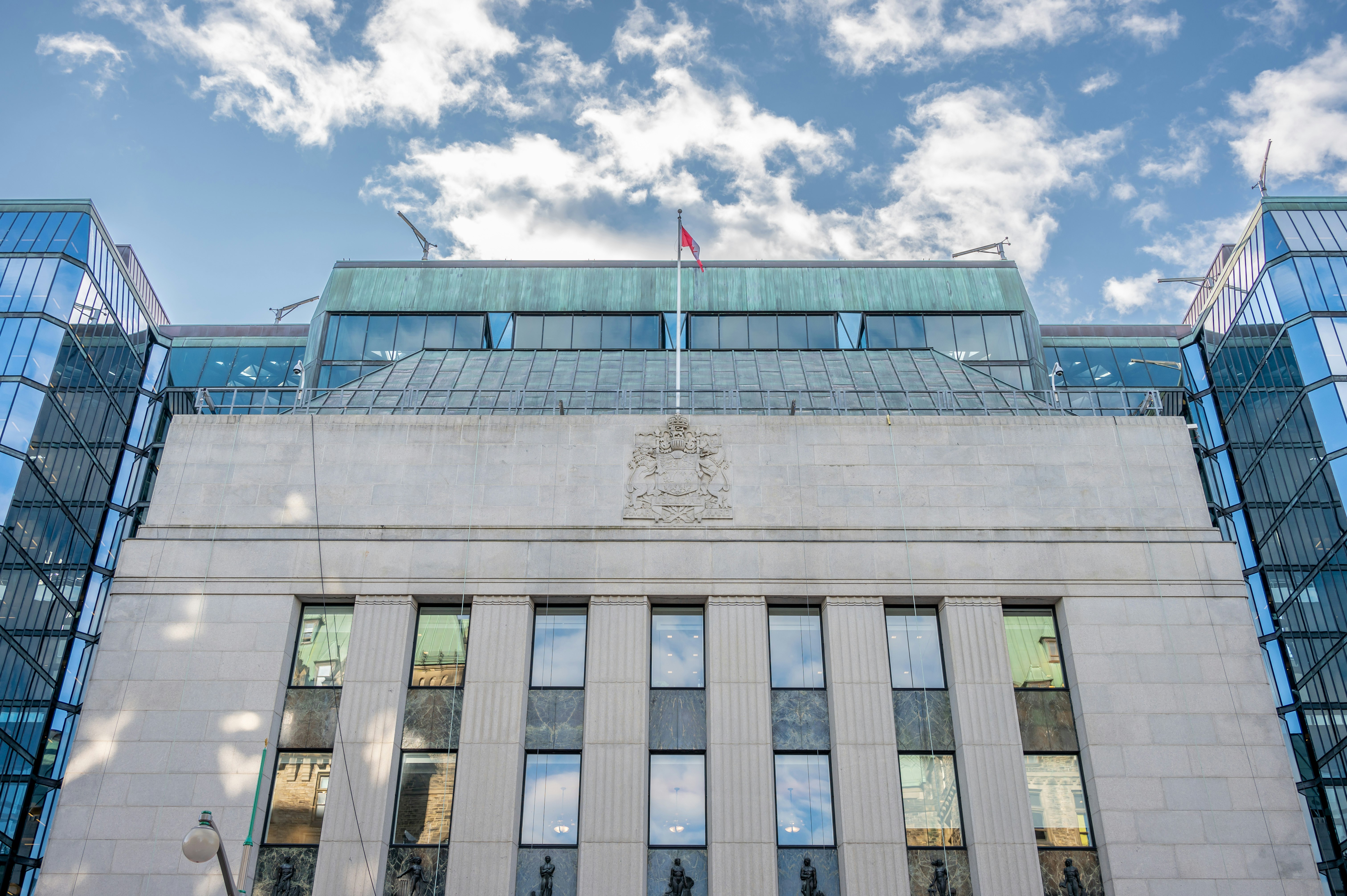
To no one’s surprise, the Bank of Canada (BoC) left its policy rate at 2.25% on July 15. While the rate remained unchanged, the BoC’s thinking hasn’t. For the first time in two years, the debate amongst economists is no longer about how quickly the BoC will cut rates, but rather when it might need to raise rates.


Today’s pause creates yet more distance from what was one of the fastest easing cycles in the BoC’s history. Between June 2024 and October 2025, rates were cut seven times in a row, from 5.00% to 2.25%. Now we have seen the sixth consecutive rate hold, further signifying a new chapter. The new Monetary Policy Report, published alongside the decision, reads less like a prelude to further cuts and more like a central bank keeping one foot near the brake.
The hold is the product of two forces pulling in opposite directions. On one side is inflation, which has climbed back above target to 3.2% (CPI) in May; its fastest pace since 2024. Rising prices typically give central banks a reason to raise interest rates to constrain prices from growing even higher. On the other side is economic growth, which remains soft after output slipped -0.1% in the first quarter. A weak economy argues for lower rates to provide stimulus.
There is a term for this: stagflation. Governor Tiff Macklem named the bind directly. Weak growth, paired with rising inflation, is a dilemma for monetary policy. Cutting rates now would risk feeding inflation, and hiking rates would risk stalling a recovery that is only just finding its feet. Ultimately, the BoC did neither; though they specifically noted that the inflation side of this argument has increased in volume in recent months.
A tale of two inflations
Look closely at that 3.2% year-over-year CPI number and it becomes less alarming than the headline implies. Almost all of it is energy costs. Gasoline prices rose 33.2% year over year in May on supply fears around the Strait of Hormuz. If one strips out the more volatile components of CPI, Canadian inflation is 2.0%; while the US was 2.9% in May and since has fallen to 2.6% for June. Thus, we would argue that Canada does not have a broad inflation problem so much as an energy problem that is disproportionately influencing the inflation data.


The United States faces an opposite, more stubborn problem. Inflation in the US is elevated even after volatile items are stripped out. Headline inflation eased slightly in June, to 3.5% from 4.2% in May, but that relief came almost entirely from falling energy prices. Underneath, core inflation, which excludes food and energy, is still stubbornly high. The Federal Reserve's preferred gauge, core PCE (personal consumption expenditure), sat higher still at 3.4%.
A healthy portion of that elevated inflation rate traces back to tariffs. Taxing imports lifts the price of many goods at once, with the costs landing on the American shopper. That makes U.S. inflation both sticky and partly self-inflicted.
Energy, the one piece that fell in June, may not stay quiet either. Oil surged back toward $85 a barrel this week after Washington reinstated a naval blockade near the Strait of Hormuz.
Divergence or convergence?
With two different inflation problems, Canada and the US could easily take two different paths, though currently both central banks appear convergent on strategy. Both have been holding rates and neither appears in a hurry to begin cutting again. However, if one looks closer, the actual story appears to be one of divergence.
The BoC’s rate is currently 2.25%. The Fed's sits at 3.50% to 3.75%. That gap of roughly 125-150 basis points is the widest in years. It is also the main reason the Loonie has slid all year. Whether it widens or narrows from here will depend largely on how inflation and growth evolve on either side of the border.
As recently as January 2026, markets had expected the Fed to cut more than 50 basis points this year, with the BoC edging their rates slightly higher. By late June, that had flipped. Markets currently price roughly 40 basis points of U.S. hikes and a steady hold in Canada.
The CUSMA wildcard
The Canada-United States-Mexico Agreement is an important factor for Canadian interest rates because it widens Canada's range of outcomes. A genuine breakdown in trade access would especially hit Canadian investment and growth. If that occurred, a subsequently weaker economy would give the BoC cause to consider cuts.
However, a contravening force is in play. The falling Loonie threatens to raise the cost of imports and would leave the BoC more constrained.


The first mandatory CUSMA review came and went July 1, 2026, without a renewal. The United States declined to extend the pact for another 16 years and triggered a process of annual reviews instead. Critically, this does not represent the end of negotiations. The agreement stays in force on its current terms until at least 2036.
We view the base case as survival of the agreement, not collapse. Letting the agreement fail would be expensive for the United States in a myriad of ways: CUSMA underpins roughly $2 trillion in annual trilateral trade. About one third of the manufacturing inputs the U.S. imports come from Canada and Mexico. The U.S. Chamber of Commerce estimates North American trade supports 13 million American jobs. A Boston Consulting Group analysis pegs the cost of a full repeal to the auto industry alone at $33 billion.
Those costs are why most analysts expect a drawn-out renegotiation. National Bank sees Washington moving to restore trade certainty before the U.S. mid-term elections and a resolution reached by year-end. If that holds, the trade cloud over Canada should thin over time, lifting one weight off the Loonie even if the rate gap persists.


A common theme runs through the conclusions above: each one depends on a future that no one can see clearly. The BoC could hike rates against sticky inflation or cut rates if trade talks sour. Based on US/Iran tensions, oil might spike again or it could drift lower. The Loonie might keep sliding or find its floor. Truly, if one builds a portfolio around any single one of those calls, much will depend on that outlook proving correct. That is a stressful and fragile way to hold wealth.
None of these events call for dramatic repositioning if an investor’s portfolio is built for uncertainty from the start. Our approach at Nicola Wealth is specifically to avoid prediction risk. Rather than bet on one future, we prepare for several: real estate and infrastructure can earn steady, inflation-linked income. Private credit should collect more when rates stay high. Global holdings typically rise in value when the Loonie falls.
Ultimately, we view an all-weather portfolio as the best defense against uncertainty. When one asset class hits a headwind, others catch tailwinds. For investors, this means that even while rates hold their breath, you do not have to.
Disclaimer
*This material contains the current opinions of the author, and such opinions are subject to change without notice. This material is distributed for informational purposes only and is not intended to provide legal, accounting, tax or specific investment advice. Forecasts, estimates, and certain information contained herein are based upon proprietary research and should not be considered as investment advice or a recommendation of any particular security, strategy, or investment product. All investments contain risk and may gain or lose value. Please speak to your Nicola Wealth advisor for advice based on your unique circumstances. Nicola Wealth Management Ltd. (Nicola Wealth) is registered as a Portfolio Manager, Exempt Market Dealer, and Investment Fund Manager with the required securities commissions. ©2026 Nicola Wealth. All rights reserved. No use or reproduction without permission. nicolawealth.com*


