


One of the most famous lines in Shakespeare’s Macbeth comes from a group of witches gathered around a cauldron:
“Double, double, toil and trouble; Fire burn and cauldron bubble”.
The line is more than a memorable piece of theatre. The witches are casting a spell designed to manipulate events and influence Macbeth’s future. Their prophecies promise power and success, but they also cloud judgement, fuel over-confidence, and ultimately contribute to his downfall.
Before considering its relevance to investing, it is worth understanding what the witches were invoking:
Double, double: Multiply or increase strength.
Toil: Exhausting, hard labor.
Trouble: Misfortune, severe difficulties, and chaos.
Combined, they are ordering their spell to inflict twice the amount of hard work and misery upon their targets (specifically Macbeth). For investors, “double-double” captures the tendency for excitement and investment to build upon themselves, while “toil” reminds us that transformative change is rarely easy, and “trouble” is what often follows when expectations run ahead of reality.
Executive Summary
- AI is real, and it is already delivering results. Across some of the world's best-run companies, AI is reducing costs, saving millions of hours, and creating measurable productivity gains today. This is not hype. AI is already creating value and it’s likely here to stay.
- Almost every transformational technology has resulted in a bubble, or consolidation. Railways, automobiles, radio, television, and the internet have all changed the world. They also attracted far more capital and far more competitors than the market ultimately required. In every case, a painful shakeout followed before a handful of winners emerged.
- The money being spent has run well ahead of the money coming in. The industry is on track to spend roughly $5 trillion on data centers and chips over five years, increasingly funded by debt, to support demand that has not yet materialized. The companies building the models are, at best, only marginally profitable.
- Today's shortages may be a symptom of a classic technology cycle. Chips, power, and equipment are all sold out, largely because the industry is building capacity years ahead of realized customer demand. Current power requirements of roughly 40GW are dwarfed by the estimated 150GW of capacity the industry is racing to build toward (which is enough to power between 100 million and 124 million homes).
This could be the classic setup for an overbuild. Long build times, debt-funded spending, and an abundance of capital chasing a compelling narrative have ended every past boom in a glut. When supply eventually catches up to demand, scarcity can quickly turn into surplus, and whoever financed the peak bears the consequences.
Is AI the transformational technology that many claim it to be, one that will fundamentally change and improve our productivity in everything from writing software or analyzing data to creating digital art forms that replace human ones?
Or, is it hyperbole run amok, consuming trillions of dollars of capital over the next few years, only to produce an expensive, commoditized application that may never turn a profit for the AI firms and hyperscalers who are committing their capital to it?
Or could it be both?
Other transformative technologies that experienced bubbles


Over the last two or three centuries, society has witnessed numerous transformational technologies such as railways, automobiles, radio, television, and the internet. In each case, the drive to maximize the potential of each of these technologies led to investment bubbles, which in turn led to a rationalization of the number of companies in each technology.
In 1907, the number of railway companies in the United States peaked at 1,564, of which 130 were considered Class I. Today, approximately 600 remain, with only six considered Class I.
Revenue has grown from about $2.6 billion to $75 billion. However, when adjusted for inflation, revenue is remarkably similar. During the same period, employment shrunk from approximately 1.5 million to 150,000.
The automobile industry followed a similar arc. The U.S. once had roughly 200 manufacturers in the 1910s, which rapidly shrank to 44 by 1927, with Ford, Chrysler and General Motors emerging as dominant players.
Today approximately 20 Original Equipment Manufacturers (OEMs) operate in the United States. The industry itself has become global with the Big Three US-based companies accounting for only 15-18% of the total worldwide market of almost 100 million vehicles.
The pattern repeats itself again in media. Radio and television have experienced similar consolidation in terms of stations and manufacturers over the last few decades. At one time, they represented a window to the world for their listeners and viewers, but now they are arguably a commodity offering.


Many of us can remember the dot-com bubble of the late 1990s.
When the bubble burst in the spring of 2000, the Nasdaq subsequently dropped by more than 80% and took 15 years to recover to its’ March 2000 high.


The internet, enabled by massive investment in fiber infrastructure, was transformational and remains so today. Yet the “Madness of the Crowds” we examined in our last newsletter was sufficient to create a level of hysteria that defines speculative manias.
Before considering whether AI is transformational, speculative or both, it is worth defining a few terms that are often used interchangeably but are not always well understood.
Defining artificial intelligence
Let’s start with the term AI itself, and since we are writing about Artificial Intelligence why not have Google AI define this for us:
Artificial intelligence (AI) is a branch of computer science focused on building systems capable of performing tasks that typically require human intelligence, such as learning from data, recognizing patterns, understanding language, and making decisions.
How AI works
Rather than following a pre-programmed set of rigid rules, AI systems process vast amounts of data using algorithms. By analyzing this data, these systems identify patterns and learn to make predictions or generate content without explicit, line-by-line human instruction.
Three types of artificial intelligence
AI spans a wide spectrum, but it is typically categorized by capability:
- Narrow AI: Systems designed to perform a single, specific task exceptionally well (e.g., product recommendations, speech recognition, or autonomous driving).
- Generative AI: A subset of AI capable of creating new, original content—such as text, images, music, or computer code—in response to user prompts.
- Artificial General Intelligence (AGI): A theoretical concept representing machines that possess comprehensive, human-level cognitive abilities across any given domain. This remains in the realm of ongoing research and science fiction.
Large Language Models
A Large Language Model (LLM) is a powerful AI system designed to understand, process, and generate human language. Built using deep learning specifically a "transformer" architecture these models are trained on massive datasets containing billions of words from books, articles, and websites to predict the next word in a sequence.
Because of their immense size and training, LLMs are not limited to simple text completion. They are highly capable of a wide range of natural language tasks, including:
- Answering Questions & Chatting: Acting as conversational assistants or search engines.
- Summarization: Condensing long documents, articles, or transcripts into quick takeaways.
- Translation: Converting text fluently between different human languages.
- Content Creation: Writing essays, emails, scripts, or marketing copy.
- Programming: Writing, debugging, and explaining computer code across multiple languages.
Popular real-world examples of LLMs include OpenAI's GPT models, Google's Gemini, and Anthropic’s Claude, SpaceX’s Grok and Meta’s Muse Spark models.
Tokens
Tokens are the fundamental building blocks of text or data that AI models process. Instead of reading full words, AI models break down text into these fragments, which can be whole words, parts of words, numbers, or punctuation.
How tokens work
Before an AI can understand or generate text, it uses a process called tokenization to convert human language into numerical IDs.
- The Rule of Thumb: One token is roughly equivalent to 4 characters, or about three-quarters of a word in English. Meaning, 100 tokens are about 75 words, and 1,000 tokens are roughly 750 words.
- Sub-word Efficiency: Common words such as "apple" may be represented by a single token, while longer or less common words are split into multiple tokens to help the AI deduce meanings across different variations of words.
Why tokens matter
Tokens influence three critical aspects of your experience and costs with generative AI:
- Context Window: AI models have a memory limit, called a context window, which is measured in tokens. This determines how much information, such as prompts, previous chats, or documents, the model can "remember" and process at once.
- Cost: Most AI providers (like OpenAI or Anthropic) bill users based on the number of tokens processed. You pay for both input tokens (the prompt you send) and output tokens (the response the AI generates).
- Speed: Because AI reads and writes sequentially, generation time scales with the number of tokens it has to produce.
Hyperscalers
A hyperscaler is a massive-scale cloud service provider that offers highly scalable computing, storage, and networking resources. These companies operate globally distributed data centers and provide infrastructure to support enterprise operations, artificial intelligence (AI), and web applications.
Key Characteristics
- Elasticity: They allow users to quickly scale resources up or down on demand to accommodate fluctuating workloads without upfront capital investments in physical hardware.
- Massive Infrastructure: To be officially classified as "hyperscale," a facility generally requires a minimum of 5,000 servers and 10,000 square feet of floor space, though major providers operate millions of servers across hundreds of global facilities.
Major providers
The leading global hyperscalers are:
- Amazon Web Services (AWS)
- Microsoft Azure
- Google Cloud Platform (GCP)
- Oracle Cloud Infrastructure
- Alibaba Cloud
Why they matter
Hyperscalers provide much of the fundamental backbone for today’s digital economy. They are uniquely equipped to handle the astronomical compute, storage, and processing power required to train and deploy complex Large Language Models (LLMs) and generative AI. By utilizing their vast networks, organizations worldwide are able to deploy software rapidly and ensure high availability for end users.
What is an AI data centre?
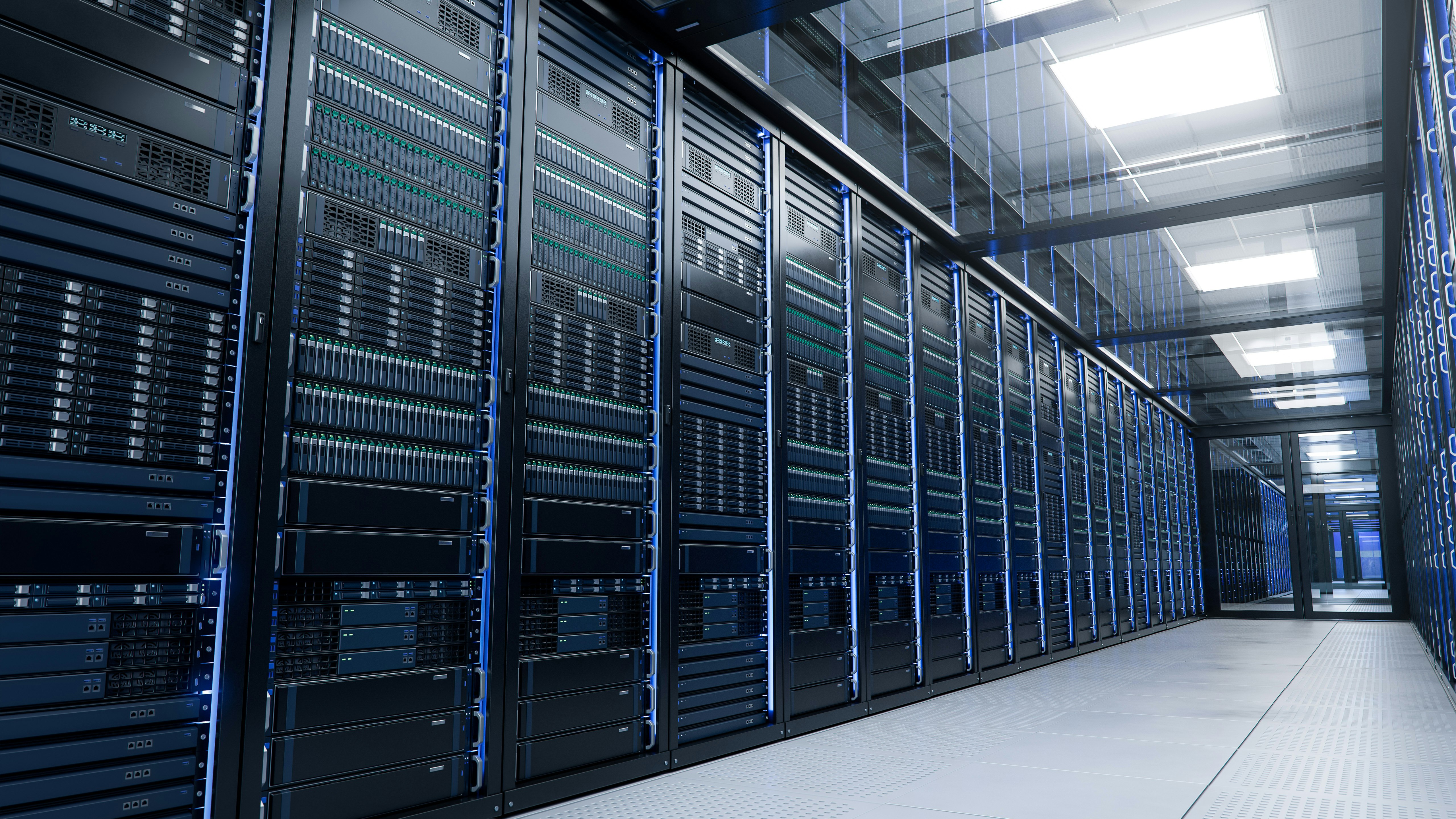
An AI data centre is a specialized facility built to train, deploy, and run artificial intelligence models. Unlike traditional data centres that primarily host websites and store information using standard central processing units (CPUs), AI data centers rely on massive clusters of graphics processing units (GPUs) designed for high-speed parallel processing, which generate significantly more heat and require advanced liquid cooling.
Key differences from traditional data centres
- High-Density Processing: AI data centre servers use specialized AI chips (like GPUs) that run thousands of calculations simultaneously, making them perfect for building Large Language Models (LLMs) and performing real-time inference.
- Extreme Power and Cooling: While a traditional server rack uses roughly 10 kW of electricity, an AI rack demands up to 60 kW. Because AI chips run so hot, most AI facilities require sophisticated liquid cooling systems rather than traditional air conditioning.
- Ultra-Fast Networking: Because large AI models cannot run on a single machine, workloads must be divided among thousands of servers. AI data centres utilize ultra-high-speed networks to ensure seamless, low-latency communication between these systems.
Why they matter
As generative AI has surged in popularity, the demand for "AI factories"—facilities designed to produce intelligence instead of just storing data—has grown exponentially. These mega-facilities power everything from conversational chatbots and autonomous vehicles to complex scientific research.
Who builds the computing power for AI data centres?
The data center hardware market for artificial intelligence is strictly divided into two types of players: traditional GPU manufacturers who dominate the open market, and hyperscale cloud providers, building custom application-specific silicon (ASICs) to lower costs.
Traditional GPU dominators
- NVIDIA: The overwhelming market leader, controlling roughly 85% of the data center GPU sector. Their hardware ecosystem includes the flagship H100, the Blackwell (GB200) architecture, and the next-generation Vera Rubin platform. Developers rely heavily on NVIDIA due to its deeply integrated CUDA software layer.
- AMD: NVIDIA’s primary competitor in general-purpose data center GPUs. Their Instinct MI300 and MI400 series offer high-bandwidth memory alternatives that are highly competitive for large language model (LLM) training and inference.
Hyperscale cloud providers (Custom Silicon / ASICs)
To reduce reliance on commercial GPUs, major tech giants design their own application-specific integrated circuits (ASICs) tailored for their respective cloud ecosystems:
- Google: Built the Tensor Processing Unit (TPU) line (including the latest eighth-generation TPU 8t and 8i platforms), which powers Gemini and Google Cloud workloads.
- Amazon Web Services (AWS): Deploys Trainium chips for heavy AI model training and Inferentia chips for low-cost, high-speed inference.
- Microsoft: Deploys its in-house Maia accelerators within Azure infrastructure to support internal systems and partners like OpenAI.
- Meta: Designs the Meta Training and Inference Accelerator (MTIA) to power its social recommendation algorithms and open-source Llama models.
- Alibaba: Developed the Xen Wu and ACCEL accelerator lines alongside rack-scale hardware to power Alibaba Cloud platforms in Asia.
Specialized infrastructure contenders
- Huawei: Facing Western export restrictions, Huawei heavily builds its own Ascend 920 AI processors to supply domestic Chinese data centers.
- Groq: Developed the Language Processing Unit (LPU), a specialized architecture focused entirely on hyper-fast AI inference speeds.
- Cerebras Systems: Creates massive Wafer-Scale Engines (WSE-3) that process data across a single giant piece of silicon to eliminate typical multi-chip bottlenecks.
Why understanding the workings of AI matters to investors
Understanding AI's building blocks helps investors separate technological promise from investment reality. AI remains a powerful and potentially transformative technology, but today's market valuations often reflect expectations of exceptional growth, profitability and adoption long before the technology has reached its full potential. Investors should recognize that a compelling product does not automatically equate to a compelling investment. The challenge is not determining whether AI will succeed, but whether current market prices adequately account for the risks and uncertainties that remain.
The rest of this report examines the potential of this technology alongside the risks embedded in the capital being invested in it.


The dichotomy of markets and technology
Artificial intelligence is being applied across a strikingly diverse range of enterprise functions. The greatest returns tend to appear where work is high-volume, repetitive, and pattern driven. Organizations of all sizes, across nearly every industry, are already finding practical applications. Consider a few examples:
- Customer service and support – IKEA's chatbot took over simple tasks such as package tracking, which freed up 8,500 workers to be retrained for a new phone-and-video home design service which is now a €1.3 billion business. Rather than cutting jobs, IKEA used AI to move people into higher-value work. It has since upgraded to ChatGPT-style models that handle complex, multi-language complaints, with 30,000 staff trained to use AI daily.
- Advertising and marketing – Meta's AI predicts which single ad each person is most likely to act on, then targets the audience, runs the auction, and even generates the ad creative automatically, so advertisers get more sales per dollar with almost no manual work. The result has been a significant improvement, turning ad dollars into actual sales, growing their Advantage+ platform from $40 billion to $60 billion in just two years.
- Software and coding – Booking.com saved 150,000 developer hours previously lost to manual scripting by boosting adoption of AI coding tools. Amazon used AI to migrate tens of thousands of production applications to newer Java, which CEO Andy Jassy said saved 4,500 developer-years of work and $260 million in annual costs from the performance gains alone.
- Legal and document review – JPMorgan's Contract Intelligence platform reviews 12,000 commercial credit agreements in seconds, work that once consumed roughly 360,000 lawyers and loan-officer hours a year. It extracts about 150 attributes per contract at accuracy exceeding human reviewers, removing a huge labor cost while cutting the risk of missed clauses and freeing expensive professionals for judgment-heavy work.
- Fraud and financial risk – Mastercard's gen-AI models lift fraud detection by roughly 20% on average, by as much as 300% in some cases, while reducing the false positives that frustrate good customers. In 2025, 42% of issuers reported saving more than $5 million in fraud losses over a two-year period, creating an edge that draws on network-scale transaction data.
- Supply chain – Walmart's in-house AI demand-forecasting, fed by weather, events, and local trends across 10,500+ stores, has reduced stockouts and overstock, improved inventory turnover, and lowered logistics costs. At Walmart's scale, even single-digit-percentage gains translate into billions in working capital and sales.
- Human resources and recruiting – Unilever's AI screening saved over 50,000 hours of candidate and recruiter time and about £1M a year, cut its hiring cycle from 4 months to 4 weeks, and reduced human bias in the process. It has now scaled this across its global recruitment of 2 million applications a year.
These examples illustrate that AI is already generating measurable benefits, including lower costs, improved productivity, faster decision-making, and in some cases entire new revenue streams.
While these examples highlight breakthroughs in productivity and revenue gains, other surveys suggest the benefits are far from universal. To borrow from Shakespeare: something is rotten in the state of Denmark. A National Bureau of Economic Research survey of nearly 6,000 executives across the US, UK, Germany and Australia found that over 80% of firms report no measurable productivity gains from AI so far, despite billions in investment, and even among leaders who use AI personally, average usage is just 90 minutes a week.
“Over 80% of companies report no productivity gains from AI so far, despite billions in investment.”
What’s the real story?
In the case of AI, function should precede form and not follow it. There is a great deal of hype surrounding the promises of this great technology, and both companies and individuals will need time, money, and trial and error to get to the promised land.
Consider several observations that help illustrate this tension between transformational technology and speculative enthusiasm:
- For the last five to six years, AI has become ubiquitous, and investment in the infrastructure supporting it has ballooned over the past two years.
- Businesses can use AI to improve operations, software development, sales effectiveness, customer service and a myriad of areas within a company. That, in turn, should lead to reduced costs, lower labour needs, and improved productivity.
- In order to support the large computing demands of AI, hyperscalers such as Meta, Oracle, Microsoft, AWS and others have invested hundreds of billions of dollars in data centres and are committing several trillion more over the next five years.
- The revenue for data centres ultimately comes from customers willing to pay for the outcomes AI promises to deliver. These data centres require huge amounts of power and large amounts of the most advanced chips from Nvidia, TSMC, Micron and others.
- Demand for chips is insatiable, and all major chip manufacturers have been generating record profits. But in recent weeks that has not helped an across-the-board decline in share prices as investors see markets getting well ahead of themselves.
- The table below illustrates a few examples. Note that the Philadelphia Semiconductor Index has gone into bear territory (more than a 20% drop) since the end of June.


Not every company positioned around AI has benefited equally. Several high-profile examples illustrate the risks of investing aggressively ahead of proven returns:
- Oracle is investing heavily in data centres but lacks the cash flow or capital of larger hyperscalers. As a result, it is operating on negative cash flow. Its debt has been downgraded to one level above junk, and its shares have dropped 52% from early June to July 27, 2026, and 65% from its’ peak in the last 12 months.
- IBM saw its stock drop by 25% on July 10 (a record for a company that has been trading on public markets since 1915). Overall, its shares are down 35% since early June on fears that its revenue will be impacted by AI. Despite billions spent on major AI acquisitions, IBM is losing its status as a defensive infrastructure provider as customers reallocate legacy IT budgets away from core mainframes.
- Salesforce, a major CRM company, has seen its shares drop almost 33% in 2026 as investors worry that AI could cannibalize Salesforce's Software as a Service (SaaS) model.
- Anthropic is marginally profitable as of Q2 2026. OpenAI and Grok are losing money and have not shown a path to profitability for several years.
- SpaceX, which owns Grok, has seen its share valuation fall below the IPO price of June 27 ($111), falling $1.2 trillion in market capitalization since its peak on June 16. The company is only now charging full rates to end users for tokens. Until now, its clients have been effectively subsidized.
- Moonshot AI, a Chinese company backed by both Tencent and Alibaba, has released an open-weight AI model called Kimi K3, which is estimated to cost roughly 50% less than Anthropic and OpenAI models while offering comparable technical capabilities.
There are also several observations from across the AI ecosystem that we believe investors should keep in mind:
- Anecdotal reports from end users suggest that many are questioning the measurable benefits of AI. It is possible that growth in end-user spending could be capped or, in some cases, reduced.
- Even with pristine balance sheets, hyperscalers are borrowing record amounts of debt, and bond markets are taking notice of the risks associated with the level of capital expenditure required, reflected through rising bond spreads and cost for debt insurance (credit default swaps).
- According to Sage Advisory Services, companies borrowed $108 billion for data centres in 2025. Year-to-date, that total has already reached $244 billion. Morgan Stanley believes total AI-related debt will reach $570 billion.
- Higher chip costs are increasing end-user prices for laptops, iPads and iPhones by as much as 20%.
- Future capital expenditure requirements for AI data centres and chips are expected to total roughly $5 trillion over the next five years. The cost of replacing chips in these data centres will also remain significant on an ongoing basis.
- Ultimately, the only sources of revenue capable of supporting this level of AI infrastructure and development are end users and customers, including businesses, institutions, governments, and individuals.
The three assumptions
In order for us to agree that this is a sustainable model, we must believe the following:
- AI is currently a sustainable, transformational technology, and end-users will pay sufficient money to create a return for the suppliers of AI models, data centres, including the costs of the chips to run them and ongoing R&D to continue to improve the AI models. Given that the estimated capital required is measured in multiple trillions of dollars, customers will need to spend, in our view, at least $1 trillion annually to generate an ROI commensurate with the risks involved.
- Current valuations of AI companies already reflect ambitious assumptions about future revenue and profit streams. If that is the case, investors must ask why the price of their shares would rise?
- We would have to believe that the renting of computing power is not a commodity despite many of the components of AI data centres being commoditized. Right now, demand exceeds supply, but why should we expect that continue?
For all of this to work, AI must ultimately prove it can deliver meaningful gains in productivity and profits for end-users. So, where is the evidence to support that?
Even if AI can make the case for it becoming an ever-increasing percentage of end-user expenditures, does that make the argument that AI companies are valued reasonably?
If AI does make its own case, or it takes too long to get there, then everything in the supply chain likely suffers, including the hyperscalers, chip makers, data centres, and the power sources that run them.
AI-related markets are a bit wobbly, perhaps reflecting the disconnect between transformative technology with potential to transform lives and the euphoria of the markets, both public and private.


The challenge isn’t whether AI works, it’s the price
We started this paper with a paradoxical question: Is AI a transformational technology or a speculative bubble? We believe it is both.
AI is a powerful technology that is already saving time, reducing costs, and improving productivity in some of the world’s best-run companies. The examples throughout this paper suggest that over time, AI will likely become deeply embedded in how businesses operate and how individuals work.
History provides an important reminder: technologies of this magnitude rarely reshape an entire economy overnight. The internet was every bit as revolutionary as its supporters claimed in 1999, yet nearly a decade passed before the real winners and the real productivity gains were visible. AI is likely to travel the same path, reaching a real destination on a longer and costlier journey than today's excitement assumes.
The greatest uncertainties may not lie within the technology itself. Bottlenecks in semiconductors and power infrastructure, and the regulatory intervention that follows could all influence the pace of adoption. In the end, the trajectory of AI may depend less on engineering than on the social, political, and environmental constraints the industry cannot simply build its way around.
That brings us to valuations, where human nature tends to take over. When a compelling story captures the imagination of investors, expectations can rise faster than fundamentals. Capital floods into opportunity, assumptions become increasingly optimistic, and future success is discounted long before it arrives.
Many AI model providers are valued on the assumption that their growth rates, competitive advantages, and market positions will prove durable. Semiconductor manufacturers, hyperscalers and infrastructure providers carry a different risk: they may be over-earning, with expectations resting on a demand and CAPEX super-cycle that many assume will continue in perpetuity. Many do not have visibility beyond the next several years.
As of the time of writing, many companies active in AI are experiencing significant share-price pressures. Are these corrections sufficient to bring valuations back to reasonable levels? We think not. A few weeks of market volatility is rarely enough to correct years of excessive market pricing. If what we are seeing now is the beginning of a reconciliation between price and value, it is likely to take many months or even years to complete the cycle.
There is an old Wall Street adage that says: “Buy the rumour and sell the news (facts)”. If June turns out to be the peak for AI valuations, then even good news about AI and its capabilities will have already been priced into the shares of companies dependent on AI.
In an environment such as this, we believe investors will find better opportunities in asset classes that have underperformed their long-term trends over the last several years.
Whether the technology succeeds is a different question from whether these stocks are worth their prices today. We believe AI is here to stay and will change how businesses operate and how people work. We are just not convinced the market has left enough room for the toil and trouble that has followed every great technological revolution before it.
Disclaimer
*This material contains the current opinions of the author, and such opinions are subject to change without notice. This material is distributed for informational purposes only and is not intended to provide legal, accounting, tax or specific investment advice. Forecasts, estimates, and certain information contained herein are based upon proprietary research and should not be considered as investment advice or a recommendation of any particular security, strategy, or investment product. All investments contain risk and may gain or lose value. Please speak to your Nicola Wealth advisor for advice based on your unique circumstances. Nicola Wealth Management Ltd. (Nicola Wealth) is registered as a Portfolio Manager, Exempt Market Dealer, and Investment Fund Manager with the required securities commissions.* ©2026 Nicola Wealth. All rights reserved. No use or reproduction without permission. nicolawealth.com


